Usage Guide
Why "Shh" Works in Almost Every Language on Earth
I noticed people quiet each other with basically the same sound no matter what language they speak, and it turns out there is a real physical reason behind it.
7 min read

Traveling and watching movies in different languages, I kept noticing something strange. No matter the country, when someone wants another person to be quiet, the sound that comes out is almost always some version of "shh." That felt too consistent to be a coincidence, so I looked into why this particular sound ended up everywhere.
It is not really a word, it is a mouth shape
The first thing that stood out is that "shh" barely counts as a word in the usual sense. It does not have a clear vowel, it does not really change across sentences, and it is produced almost the same way no matter what language a person speaks natively. That already hinted the explanation had less to do with language and more to do with how the human mouth physically makes this sound.
Making this sound involves narrowing the space between the tongue and the roof of the mouth, pushing air through a tight gap. This creates a hissing, breathy sound rather than a clear tone, and almost every human mouth is built to produce something close to it with very little effort.
This kind of sound cuts through noise unusually well
A hissing, high-frequency sound like this sits in a range that human hearing is naturally tuned to notice quickly, even over background noise or other people talking. That matters a lot in the exact situation where shushing gets used: a room that already has some noise in it, where a quiet, gentle sound would simply get lost.
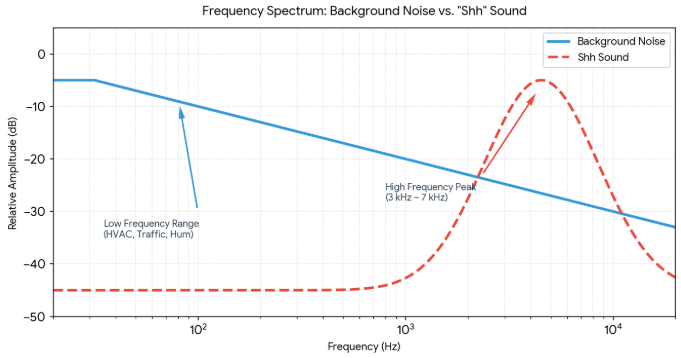
So the sound needed to do two contradictory things at once: stay soft and non-aggressive, while still being noticeable enough to interrupt whatever was happening. A hiss produced this way manages both, which is not something every sound can pull off.
It shows up with strikingly similar versions across unrelated languages
What convinced me this was not just a Western habit was seeing how similar versions of the sound show up in languages that have almost nothing else in common, from completely different language families with no shared history. A rough, informal comparison looks something like this.
| Language family | Common quieting sound |
|---|---|
| Germanic (e.g. English, German) | "Shh" / "Sch" |
| Romance (e.g. Spanish, French) | "Chut" / "Shh"-like hiss |
| East Asian languages | Similar soft hissing sound used informally |
| Various unrelated language groups | Consistently some hissing or breathy sound, rather than a full word |
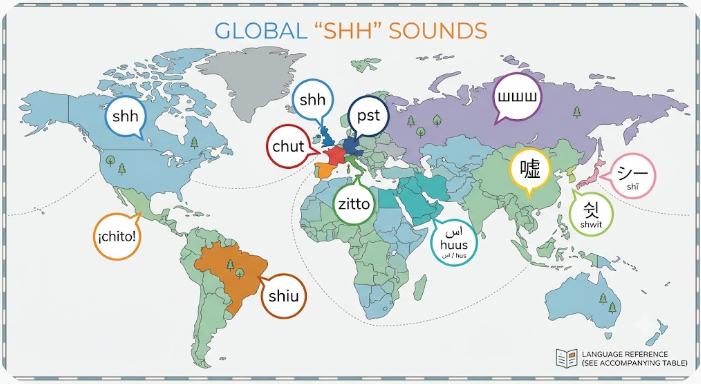
None of these languages borrowed the sound from each other in any direct way most linguists would point to. The far more likely explanation is that people in very different places independently landed on a similar solution, because the same physical and acoustic constraints applied everywhere.
Babies seem to respond to it before they understand any language at all
One detail that stuck with me is how caregivers instinctively make a similar hissing sound to soothe a crying baby, long before that baby understands any spoken language. Some researchers have connected this to the whooshing, hissing quality of sounds infants may have experienced before birth, though this part is more of an interesting hypothesis than something fully settled.
What is clearer is that a soft hiss tends to interrupt and calm in a way that sharper or louder sounds do not, which lines up with why it works so well both for quieting a noisy room and for calming a distressed infant.
It ended up being less about culture and more about acoustics
I went into this expecting some kind of shared cultural origin, maybe one language spreading the habit to others over centuries. Instead, the more convincing explanation is almost the opposite: the human mouth and ear are built in a way that makes this specific kind of sound unusually effective at cutting through noise while still sounding non-threatening, so people all over the world arrived at nearly the same solution on their own.