Curious Stories
Why You Sound Better Singing in the Shower (It Is Not Your Imagination)
In the shower I sound like a confident, full-voiced singer. In the living room, the same song falls flat. It turns out the bathroom really does change your voice. Here is the acoustic science, a simple test you can try tonight, and how to get some of that sound outside the shower.
7 min read
Every time I sing in the shower, I turn into a completely different singer. Fuller voice, more confidence, notes that just seem to hang in the air. Then I try the same song in the living room and it falls flat. For years I assumed it was all in my head. It is not. Your bathroom really does change how your voice sounds, and once you know why, you can even borrow a bit of that effect for the rest of the house.
Your bathroom is a free reverb machine
A bathroom is basically a small box of tile, glass, mirrors and enamel. All of those surfaces are hard and smooth, so they reflect sound instead of absorbing it. In a living room full of carpet, curtains and a sofa, a lot of your voice is soaked up the moment it leaves your mouth. In a shower, almost nothing gets absorbed. Your voice bounces from wall to wall and back to your ears again and again.
That trail of reflections is reverb, the same effect a music producer adds to a vocal track to make it sound bigger and more polished. In a typical tiled bathroom, sound can keep ringing for around a second after you stop. In a furnished living room, it dies away in a fraction of that.
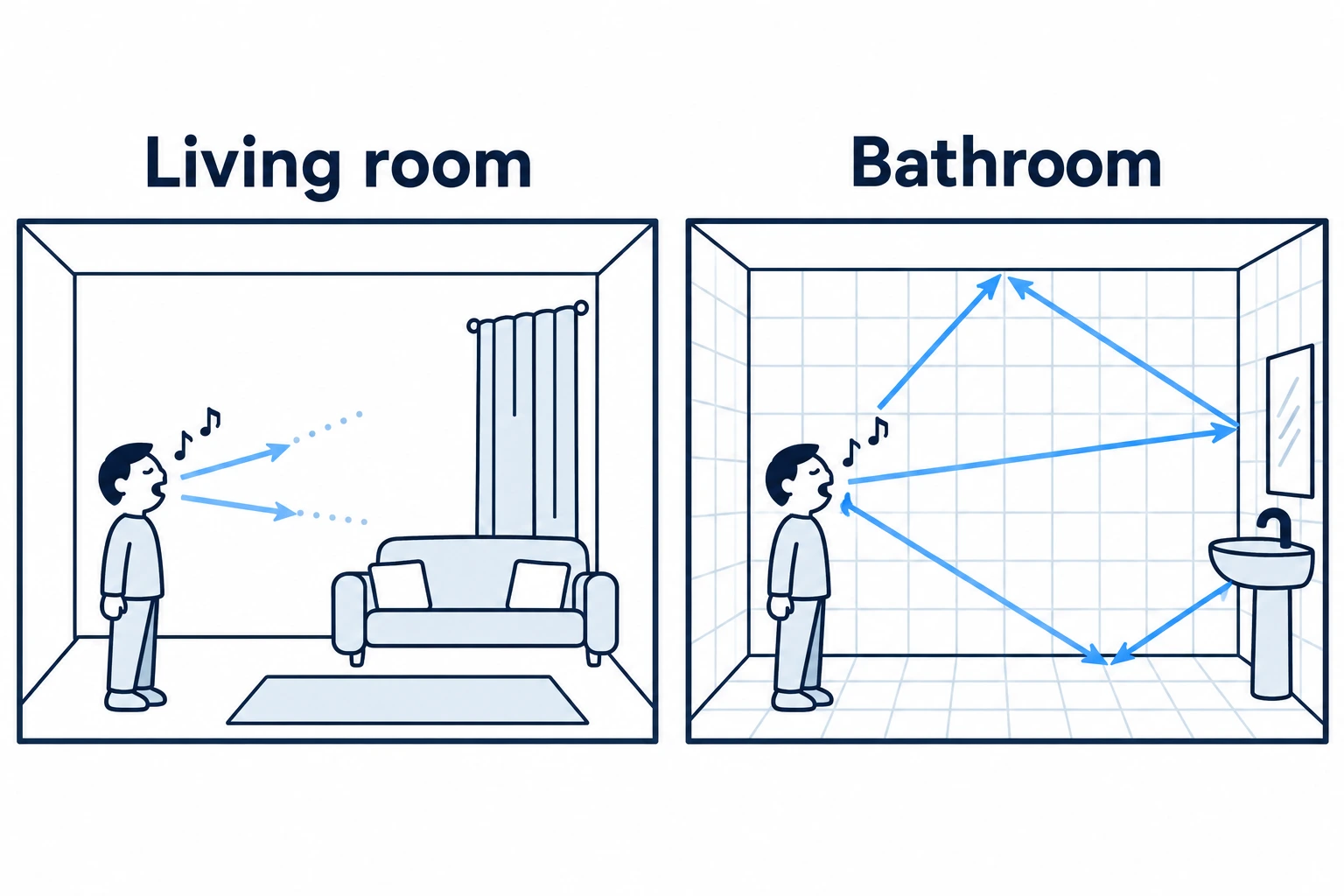
Reverb does more than make you louder. It smears each note into the next one, which covers small pitch wobbles, rough edges and moments where your breath runs short. That is why your singing suddenly sounds smoother in there.
Small is the secret
You might think any echoey space would do the same thing, but size matters a lot. In a small bathroom, the walls are only a meter or two away, so the reflections come back within a few thousandths of a second. That is too fast for your brain to hear them as a separate echo. Instead, it fuses them with your original voice, and you hear one thicker, richer sound.
In a big hallway, a stairwell or an empty gym, the walls are farther away. The reflections arrive later and start to sound like a distinct echo. Your voice feels distant and a little messy rather than full. Plenty of hard surfaces, completely different result.
| Space | Surfaces | What happens to your voice |
|---|---|---|
| Living room | Carpet, sofa, curtains | Absorbed quickly, sounds dry and thin |
| Stairwell or big hallway | Hard, but large | Echo arrives late, sounds distant |
| Shower or bathroom | Tile, glass, small | Fast reflections blend in, sounds full |
Some notes get a boost
Here is the part most people have never heard of. In a small room with parallel hard walls, sound waves at certain pitches bounce back and forth and line up with themselves. These are called standing waves, or room modes. At those particular frequencies, the room acts like an amplifier, and the sound blooms.
The frequencies depend on the size of the room, and in a typical bathroom many of them land in the low and lower-middle range, roughly where the lower part of a singing voice sits. That is why a deep note in the shower can suddenly feel huge and warm, as if the whole room is singing along. It is also why some notes sound amazing and others feel ordinary, even in the same song.

Try this tonight: find your bathroom note
You can hear room modes for yourself in about a minute.
- Stand in the middle of the bathroom with the door closed.
- Hum a low note and slowly slide your pitch up, like a siren.
- Listen for the moment the room suddenly booms. At one or two pitches, the hum gets noticeably louder and you may even feel a slight buzz in your chest or the walls.
- That is your bathroom note. Try the same slide in your bedroom and you will likely find a different note, or barely any boom at all.
It is a fun little experiment to do with kids, too. It turns an invisible bit of physics into something you can actually hear.
Steam, water and nobody listening
The room is the main reason, but a few other things quietly help.
Steam is good for your vocal folds. Your vocal folds vibrate most easily when they are well hydrated. Warm, humid air helps keep them moist, which is why singers often breathe in steam before performing. A hot shower is basically a free steam session.
Running water covers small mistakes. The steady hiss of the shower acts like a soft layer of background noise. It masks little cracks, breath sounds and wobbles. It also tends to make you sing a bit louder and with more support, which on its own makes a voice sound stronger.
You are relaxed and alone. No audience means less tension in your throat and shoulders. A relaxed body produces a freer, more open sound. Many people simply sing better when they are not worried about who is listening.
Why your recorded voice sounds worse
If you have ever recorded yourself singing and been disappointed, there is a second effect at play. When you sing, you hear your voice through the air and also through the bones of your skull. Bone conduction carries the low frequencies especially well, so your own voice always sounds deeper and warmer to you than it does to everyone else. A recording only captures the air part, so it sounds thinner than what you are used to. Add the missing bathroom reverb, and the gap feels even bigger.
How to get a bit of shower sound anywhere
- Add reverb when you practice. Most karaoke and singing apps have a reverb or echo setting. A small amount gives you that shower confidence. Just practice without it sometimes too, so you know what your voice really sounds like.
- Sing facing a hard wall or window. In a soft room, standing close to a bare wall gives you more reflection back to your ears.
- Do not record vocals in the bathroom. It sounds great live, but on a recording that strong reverb and the boomy room notes usually make the voice sound boxy and hard to edit. For recording, a closet full of clothes works much better. Record it dry, then add reverb later in your editing software where you can control it.
- Use steam before you sing. Drinking water during the day and breathing in steam before a performance helps your voice wherever you sing.
So, are you a better singer in the shower?
Honestly, not quite. The bathroom is doing a lot of the work: natural reverb, boosted notes, steam and a relaxed mood all stack up in your favor. That was a little disappointing to learn at first. But it also means the voice you hear in there is not fake. It is your real voice in a room that happens to flatter it. And now that you know what the room is adding, you can bring a bit of it with you everywhere else. So go ahead and keep singing in there. Science is on your side.