
Curious Stories
Cheap vs Expensive Earbuds: What You Actually Get When You Pay More
Earbuds range from 20 dollars to well over 300. After years of buying both ends, I found that the extra money rarely buys what people think. Here is where it really goes, where it stops making a difference, and the one cheap fix that matters more than price.
8 min read
My first pair of wireless earbuds cost about 25 dollars. My current pair cost almost ten times that. When I upgraded, I expected to put them in and hear my favorite songs in a completely new way. That did not happen. They sounded better, sure, but not ten times better. What surprised me was everything else: the quiet on the subway, how clear my voice was on calls, how they still worked fine after two years in a jacket pocket.
That gap between what I expected and what I got made me curious. So I spent some time reading teardowns, measurement data and listening studies to figure out where the money in an expensive pair actually goes. Some of it is worth every cent. Some of it is not. And the single biggest factor in how earbuds sound costs almost nothing.
The thing that matters most is not on the price tag
Before talking about price, this needs to come first. The fit of the ear tip in your ear has a bigger effect on sound than almost anything else. Earbuds rely on a sealed space inside your ear canal to produce bass. If the tip is even a little too small, air leaks out and most of the low end disappears. The music suddenly sounds thin and tinny, and people blame the earbuds.
I learned this the embarrassing way. For months I thought my cheap pair had weak bass. Then I tried the larger tips that came in the box, and it was like swapping to a different product. Most earbuds come with three or four sizes for a reason, and many people never try anything except the medium ones that come pre-installed.
A 30 dollar pair with a good seal can sound better than a 300 dollar pair with a bad one. Before judging any earbuds, try every tip size and pick the one that feels snug and blocks outside noise the most.
Many expensive models now include a fit test in their app that plays a sound and checks whether the seal is good. It is a genuinely useful feature, but you can do a rough version yourself: play music, then gently press the earbud a little deeper. If the bass jumps up, your seal was not good enough.
Sound quality: better, but with fast diminishing returns
Expensive earbuds usually do sound better, but the reason is mostly tuning rather than exotic hardware. The tiny speaker inside, called the driver, is not wildly more expensive in a premium model. What costs money is the engineering time spent shaping the sound so it is balanced and pleasant, and the processing chip that corrects the sound in real time.
Audio researchers have spent years studying what kind of sound most listeners prefer. One of the most well known findings is that, in blind tests where people cannot see the brand or price, most listeners tend to prefer a similar balanced sound with a moderate bass boost. Some cheap earbuds land close to that target. Some expensive ones miss it on purpose to create a signature sound. Price and preference line up less than you might expect.
In my own experience, the jump from a 20 dollar pair to a solid 70 to 100 dollar pair is easy to hear. Clearer vocals, less harshness, bass that sounds tight instead of boomy. The jump from 150 to 300 dollars is much smaller, and for casual listening on the bus, I honestly could not always tell.
Bluetooth is the bottleneck most people forget
Here is something that changed how I think about audio quality. Every wireless earbud has to compress the music to send it over Bluetooth. The method used is called a codec. Common ones include SBC, AAC, aptX and LDAC. Almost all of them throw away some information to fit through the wireless connection, no matter how good the earbuds are.
That means a high quality lossless music file gets squeezed on the way to your ears. There are newer formats that can carry close to lossless sound over Bluetooth, but they only work when both your phone and your earbuds support the same one. iPhones, for example, use AAC for Bluetooth audio. So paying extra for earbuds that support a fancy high resolution codec only helps if your phone speaks the same language. It is worth checking before you buy.
Where the money really goes
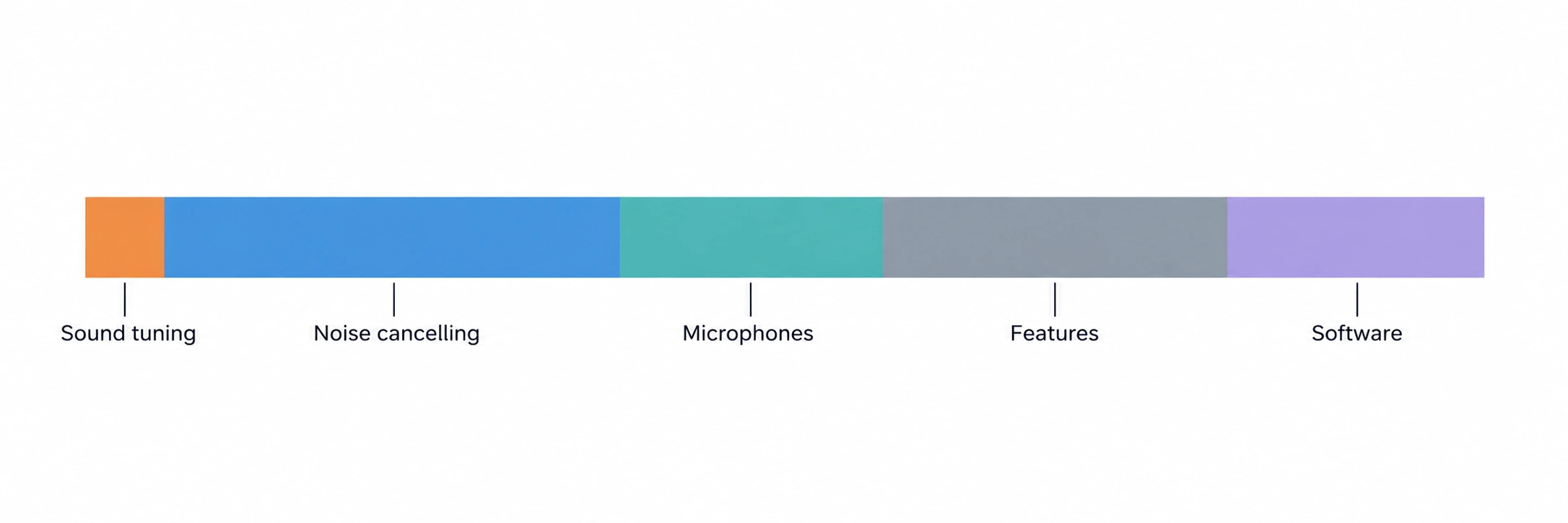
Once I stopped focusing on sound alone, the price differences started to make a lot more sense. Most of the extra cost goes into features that have nothing to do with how a song sounds in a quiet room.
Noise cancellation. This is the biggest real-world difference I noticed. Good active noise cancellation uses several microphones and a fast chip to listen to the world around you and play the opposite sound wave to cancel it. Cheap models often have the feature on the box, but the effect is weak. Premium models can turn a loud subway car or airplane cabin into a low murmur. They are especially good at steady low sounds like engines and air conditioning. Sudden or high sounds, like voices, still get through more.
Call quality. The microphones on earbuds sit far from your mouth, so picking up your voice clearly in a noisy street is hard. Expensive pairs use multiple mics, bone conduction sensors in some models and noise reduction software to isolate your voice. If you take a lot of calls outside, this is one of the clearest reasons to spend more.
Transparency mode. This lets outside sound in through the microphones so you can hear announcements or talk to someone without taking the earbuds out. On cheap pairs it can sound robotic. On good ones it sounds surprisingly natural, almost like not wearing anything.
Convenience features. Connecting to a laptop and phone at the same time, pausing automatically when you take one out, wireless charging, a findable case, spatial audio with head tracking. Each one is small. Together they make daily use smoother, and they are a large part of what you pay for.
Software and support. Premium brands tend to keep updating firmware for years, fixing bugs and sometimes adding features. Some newer models have even added hearing health tools, like hearing tests and hearing assistance modes, through updates. Cheap brands often never update at all.
| Price range | What you usually get | Who it suits |
|---|---|---|
| Under 30 dollars | Basic sound, weak or no noise cancellation, average calls | Gym, backup pair, kids |
| 50 to 100 dollars | Noticeably better sound, decent noise cancellation, app with EQ | Most people, best value range |
| 150 to 250 dollars | Strong noise cancellation, clear calls, natural transparency, long software support | Daily commuters, frequent flyers, lots of calls |
| Above 250 dollars | Small gains in sound and features, premium materials and brand | Enthusiasts who want the best of everything |
The uncomfortable truth about battery life
This is the part I wish someone had told me before my first expensive purchase. Earbuds use tiny lithium batteries, and those batteries wear out with use, usually losing noticeable capacity after two or three years of daily charging. In almost all earbuds, the battery cannot be replaced. When it fades, the whole product is effectively done.
That applies to cheap and expensive models alike. A 300 dollar pair does not necessarily last longer than a 60 dollar pair on the battery side. So when you think about price, it helps to think in cost per year. Spending a lot makes the most sense when you will really use the premium features every day during those few years.
A few habits help stretch the battery. Avoid leaving the case at zero percent for long periods, keep it out of hot cars and direct sun, and turn on any optimized charging option in the app if it exists.
How I would choose now
- Start with where you will use them. Quiet home and office listening does not need top noise cancellation. A daily train commute or frequent flights absolutely benefit from it.
- Check your phone codec. If your phone only supports AAC, do not pay extra for a high resolution codec it cannot use.
- Think about calls. If you take calls outdoors often, prioritize microphone quality over sound quality. It is the hardest thing for cheap earbuds to do well.
- Try every ear tip. Whatever you buy, spend five minutes finding the right size. It is the cheapest upgrade there is. Third party foam tips can also help if the included ones never seal well.
- Watch the volume. Better noise cancellation has a hidden health bonus. When the background is quieter, you naturally listen at a lower volume, which is much kinder to your hearing over the years.
So, are expensive earbuds worth it?
Sometimes, but usually not for the reason people buy them. If you expect more expensive earbuds to make music sound dramatically better, you will probably be a little disappointed above the 100 dollar mark. If you want a quieter commute, clearer calls and a pair that keeps improving through updates, the extra money can be worth it. And whichever pair you end up with, the best thing you can do for the sound costs nothing at all: take five minutes, open the box of spare tips, and find the one that actually fits your ears.