
Curious Stories
Why the Sound of Someone Chewing Makes You Want to Leave the Room
For years I thought I was just an impatient person. A coworker eating an apple, someone slurping soup, a pen clicking in a quiet meeting, and I would feel a wave of anger I could not explain. Then I learned it has a name. If this sounds familiar, you are far from alone.
9 min read
There was a guy at my old job who ate an apple at his desk every day at exactly three in the afternoon. He was a nice person. He never did anything wrong. And every single day, the moment I heard that first wet crunch, my whole body went tight. My face got hot. I would put on headphones, turn the music up, and still hear it underneath. Some days I just got up and walked to the bathroom until he was done.
I never told anyone, because how do you explain that? I am furious at you for eating fruit. It sounded ridiculous even in my own head. I figured I was just irritable, or a little too sensitive, and that I should get over it.
Then one night I typed something like why do chewing sounds make me so angry into a search bar, half expecting nothing. Instead I found a word, a pile of research, and thousands of people describing my exact feeling. The word was misophonia.
What misophonia actually is
The term was coined in 2001 by two hearing researchers, Pawel and Margaret Jastreboff. It literally means hatred of sound, which is a bit dramatic, but honestly not far off. It describes a strong emotional reaction to specific, usually quiet, everyday sounds. Not loud ones. Specific ones.
The reaction is not mild annoyance. For a lot of people it is a sudden rush of anger, disgust or panic, sometimes with a racing heart, tense muscles and a strong urge to escape or make it stop. And it usually shows up the instant the sound starts, before you have time to think about it.
The sounds that set people off, often called triggers, are surprisingly consistent:
- Chewing, crunching and lip smacking
- Slurping, gulping and loud swallowing
- Heavy breathing, sniffing and throat clearing
- Pen clicking, nail tapping and keyboard clatter
- Foot tapping or a leg bouncing against a table
Reading that list was a strange moment for me. It was basically my personal list of things I had never admitted bothered me.
It is not about volume
This is the part that confused me for so long. I could stand next to a jackhammer on the street and feel fine. A concert did not bother me at all. But someone quietly chewing gum across the table could ruin my evening. If my ears were just sensitive, it should have been the other way around.
That is because misophonia is not really a hearing problem. People with it usually have perfectly normal hearing. The issue is how the brain reacts to certain sounds, not how loud the sounds are. It also helps to know that it is different from a few other things it often gets mixed up with.
| What it is | What sets it off | How it feels |
|---|---|---|
| Ordinary annoyance | Any irritating noise, especially when tired | Mild, passes quickly, easy to ignore |
| Misophonia | Specific sounds, often made by other people, even when quiet | Sudden anger, disgust or panic, urge to escape |
| Hyperacusis | Ordinary sounds at everyday volume | Sounds feel physically too loud or even painful |
What is happening in the brain
This was the part that made me feel a lot less crazy. In 2017, researchers at Newcastle University in the UK scanned the brains of people with and without misophonia while they listened to different sounds. For people with misophonia, trigger sounds like chewing and breathing caused a much stronger response in a brain region called the anterior insula, which helps decide what deserves our attention and is closely tied to emotions. That region was also more strongly connected to areas that handle memory and fear.
A few years later, the same group found something even more surprising. In people with misophonia, hearing someone chew also activated the part of the brain that controls the mouth, jaw and throat movements of the listener, more than it did for other people. The researchers suggested that the brain may be over-mirroring the action behind the sound, almost as if it is experiencing the chewing from the inside. That might explain why the most hated sounds are so often ones made with the mouth.
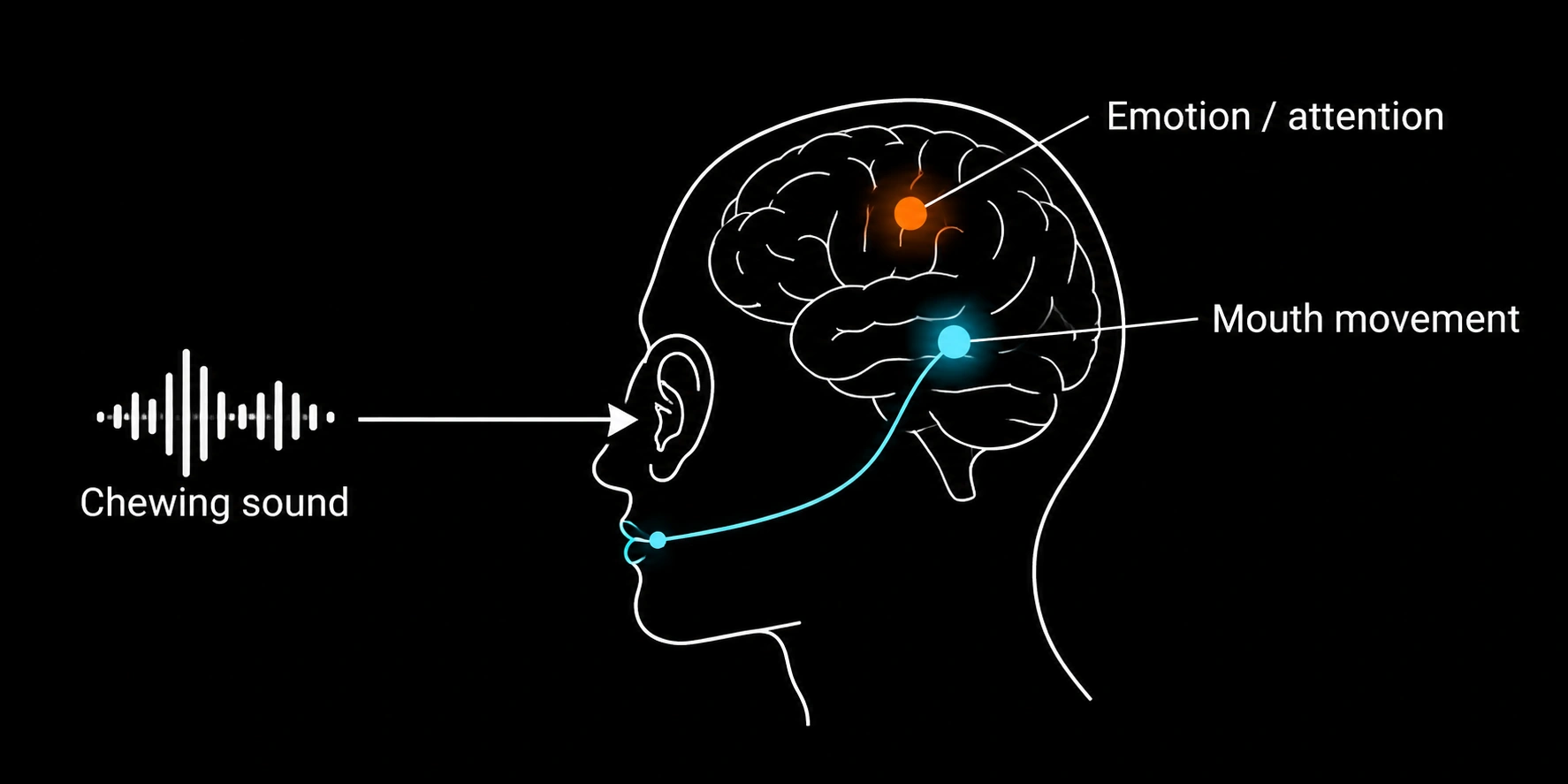
It is not a lack of patience or a bad attitude. Brain scans show a measurably different reaction to these sounds. Knowing that took a lot of guilt off my shoulders.
Why it is often worst with the people you love
This is the cruel twist. For many people, the reaction is strongest with family members, partners and close friends. A stranger chewing on the bus is irritating. My dad chewing at the dinner table when I was fourteen was unbearable. I remember asking to eat in my room and making up excuses, and I am pretty sure he thought I was just being a moody teenager.
It turns out that is very common. Misophonia often starts in late childhood or the early teens, and the first triggers are frequently sounds from people at home. Researchers are still working out why, but it may have to do with how often we hear those sounds, in close quarters, with no easy way to leave. Over time the brain links that person and that sound with the same rush of anger, and the link gets stronger every time.
If you live with someone who has this, it can feel very personal. It is worth knowing that it usually is not about you at all.
How common is it?
Far more common than I would have guessed. A large survey of adults in the UK, published in 2023 by researchers at King's College London, found that nearly one in five people reported misophonia symptoms strong enough to affect their daily lives. Many of them had never heard the word. Like me, they just thought they were difficult people.
In 2022, a group of experts from several countries also agreed on a shared definition, which matters because for a long time doctors and researchers were all using slightly different descriptions. It is still not listed as its own official diagnosis in the main psychiatric manuals, but it is being taken a lot more seriously than it was even ten years ago.
A quick self check
This is not a diagnosis, just the questions that made things click for me. If you find yourself nodding at most of them, it might be worth reading more or talking to someone.
- Do certain quiet sounds, like chewing or breathing, make you feel angry or disgusted almost instantly?
- Is the reaction much stronger than the sound seems to deserve, and do you know that while it is happening?
- Do you avoid meals, rooms, meetings or people because of specific sounds?
- Is it worse with people you are close to?
- Do you sometimes copy the sound or movement, like chewing loudly yourself, without really meaning to?
That last one surprised me. Some people with misophonia find themselves quietly mimicking the trigger. I caught myself doing it once, chewing in sync with someone across the table, and had no idea why. It lines up with the mirroring research, and it seems to be a way the brain tries to take back control.
What has actually helped me
There is no quick cure, and I still have bad days. But a few things made a real difference.
Background sound instead of silence. Quiet rooms are the worst, because every small noise stands out. I keep soft music, rain sounds or brown noise playing during meals at home and at my desk. It does not block triggers completely, but it takes the edge off a lot.
Earbuds with noise canceling, used carefully. They are great on trains and in open offices. I try not to wear them all day, though. Some specialists warn that blocking everything all the time can make you even more sensitive when you take them off.
Changing where I sit. It sounds small, but sitting diagonally from someone instead of right across from them helps. So does avoiding a direct view of their mouth. Watching the chewing makes it worse for me.
Telling people, kindly. I eventually told my family and a couple of coworkers. I framed it as a quirk in how my brain handles certain sounds, not as a complaint about them. Most people were completely fine with it, and a few said they had something similar. Being able to say I need music on for dinner, it is a me thing, is so much easier than silently suffering.
Stepping out before the anger peaks. I used to sit there and grit my teeth until I snapped. Now I leave for a minute when I feel it building. A short break works better than trying to tough it out.
If it is seriously affecting your relationships, work or mental health, it is worth talking to a professional. Cognitive behavioral therapy has shown real benefits for misophonia in clinical studies, and some audiologists and psychologists now specialize in it.
If someone you know has it
Please do not take it personally, and please do not chew louder as a joke. I promise it is not funny on the other side. Small things help a lot: having music on during meals, being understanding if they eat somewhere else sometimes, or just not making a big deal when they need a minute. They are usually already embarrassed about it.
The apple guy
I never did tell my coworker about the apples. I left that job a while ago. But I think about him sometimes, eating his snack completely unaware that the person two desks over was quietly having a small crisis every afternoon. He did nothing wrong. Neither did I. My brain was just doing something it had learned to do, loudly and without asking. Finding out that it had a name, that other people felt the same thing, and that there were ways to make it easier honestly changed how I see myself. If you have been silently fighting the sound of other people eating, you are not rude, and you are definitely not the only one.