
Curious Stories
Can You Really Hear the Ocean in a Seashell? I Tested It With a Cup, a Jar and My Hand
Hold a seashell to your ear and you hear the sea. Or is it your own blood rushing? I spent an evening testing shells, cups, jars and my bare hand to find out what that sound really is. The answer is simpler, and a lot more interesting, than either story.
7 min read
There is a large spiral shell on a shelf at my parents house. As a kid I would press it to my ear and listen to what my grandmother called the sea that lives inside. Later, a classmate told me that was nonsense, that the whooshing was just my own blood pumping past my ear. For years I believed him.
Recently I picked up that same shell again and wondered whether either explanation was actually true. So instead of reading one answer and moving on, I cleared the kitchen table and tested it. Here is what happened.
The setup
Nothing fancy. The big spiral shell, a smaller clam-style shell from a beach trip, a regular coffee mug, a tall drinking glass, an empty jam jar and my own two hands. I did every test twice: once in the kitchen with the fridge running and a window open, and once late at night in a closet full of coats, the quietest spot in the house.
Test 1: The shell, then the mug
The big shell did exactly what I remembered. A soft, rolling whoosh, low and wavy, a lot like distant surf. It honestly is a lovely sound.
Then I tried the coffee mug, open end against my ear. Same thing. Not identical, but clearly the same kind of whoosh, just a little higher in pitch. The tall glass gave a lower, deeper tone. The jam jar landed somewhere in between.
So whatever the ocean sound is, the ocean is not required. A kitchen mug produces it just fine.
Test 2: The blood theory
If the sound were my blood, two things should be true. It should pulse along with my heartbeat, and it should get louder after exercise, when my heart is pumping harder.
I listened for a pulse and did not find one. The whoosh was steady. Then I ran up and down the stairs a few times until my heart was pounding and listened again. No change at all. My heart was clearly racing, and the shell sounded exactly the same as before.
The blood theory does not hold up. Sorry, old classmate.
Test 3: The quiet closet
This was the test that gave the game away. In the closet, surrounded by heavy coats, the shell went almost silent. I could still hear something faint, but the rich, rolling sea from the kitchen was mostly gone. Back in the kitchen with the fridge humming and traffic outside the window, the sea came right back.
So the sound depends on the room, not on the shell or on me. The noisier the space around you, the bigger the ocean.
| What I held to my ear | In the noisy kitchen | In the quiet closet |
|---|---|---|
| Large spiral shell | Deep, rolling whoosh | Barely anything |
| Small clam shell | Higher, thinner hiss | Very faint |
| Coffee mug | Clear whoosh, medium pitch | Very faint |
| Tall glass | Lower, hollow tone | Barely anything |
| Cupped hand | Soft whoosh, changes as I move my fingers | Almost nothing |
What is actually going on
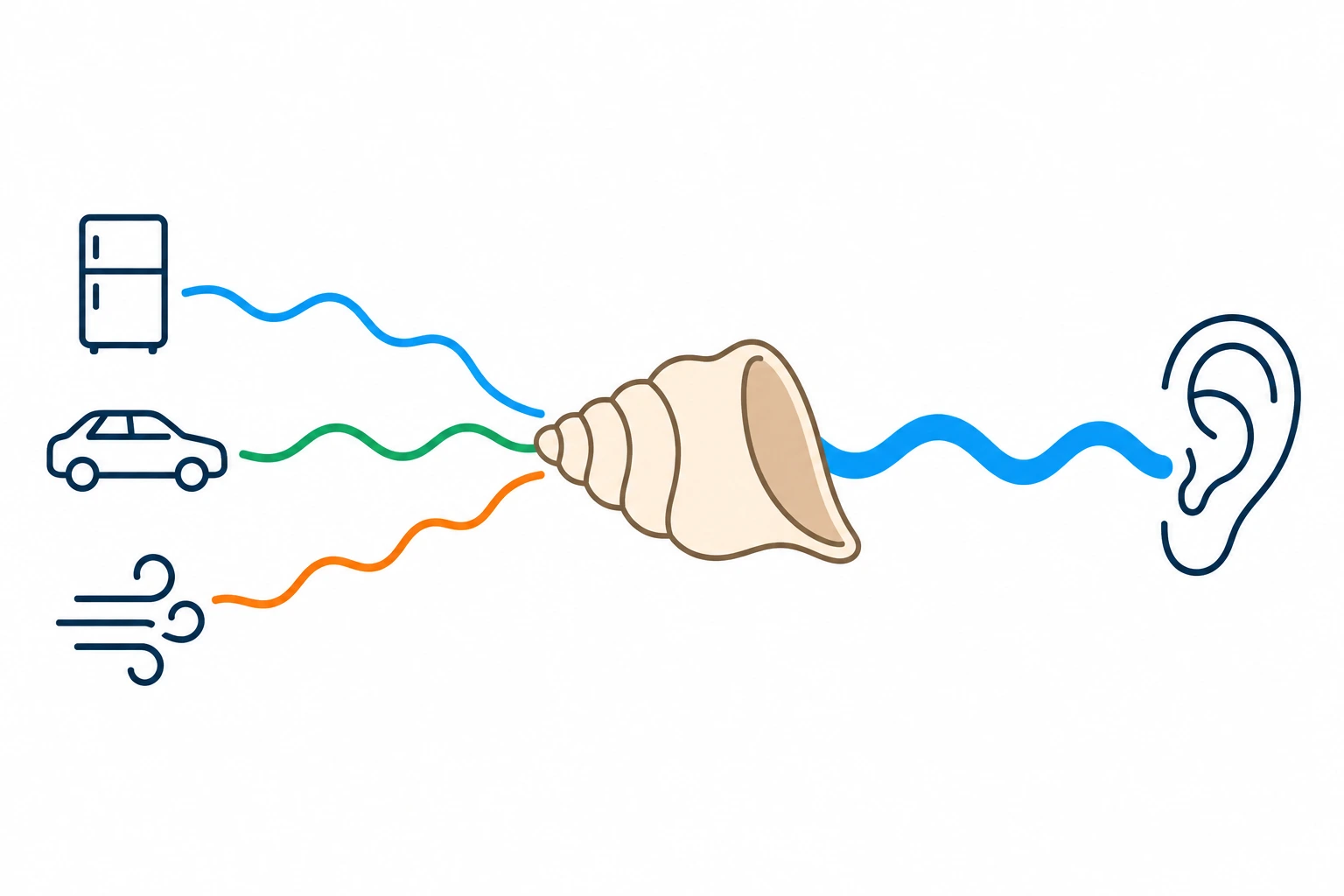
Every room is full of quiet background sound. Air moving, a fridge, distant cars, the hum of electronics, people talking two floors away. Most of the time your brain ignores all of it. Mixed together, it forms a kind of soft, shapeless noise that contains a little bit of every pitch.
When you cover your ear with a shell, you create a small chamber of trapped air with an opening. Like blowing across the top of a bottle, that chamber has a pitch it naturally prefers. Physicists call it a resonance. Out of all the background noise in the room, the shell picks out the pitches that match its own shape and size and makes them a little louder, while the rest stays quiet.
The shell does not make any sound of its own. It acts like a filter that takes the hidden noise already in the room and boosts a narrow slice of it until you can hear it.
That explains everything from my kitchen table. A bigger cavity, like the tall glass or the large spiral shell, favors lower pitches, so it sounds deeper. A smaller one, like the mug or the clam shell, favors higher pitches. In the closet there was very little background noise to begin with, so there was almost nothing for the shell to boost.
So why does it sound like the sea?
This is the part I find most charming. Real ocean waves produce a broad, rushing noise that rises and falls. Filtered room noise coming out of a shell is also a broad, rushing noise. The two are genuinely similar in character. Add the tiny shifts you make without noticing, a slight tilt of the shell, a small movement of your head, and the sound swells and fades a little, just like waves.
Then your brain does the rest. A shell comes from the beach, so when you hold one and hear a rushing sound, the obvious match is the sea. Hold a coffee mug to your ear and most people describe it as wind or a hum instead. Same physics, different expectation.
A 160-year-old version of the same trick
While reading about all this, I learned that scientists once used this exact effect on purpose. In the 1860s, the German physicist Hermann von Helmholtz built a set of hollow brass spheres, each with a small opening on one side and a little nub on the other that fit into the ear. Each sphere was tuned to one pitch. Holding one to his ear, he could pick out whether that particular pitch was hiding inside a musical chord or a spoken vowel.
They are still called Helmholtz resonators, and the same idea shows up today in car exhausts, speaker boxes and the round hole in an acoustic guitar. In a way, my grandmother was handing me a piece of lab equipment and calling it the sea.
Try it yourself in two minutes
- Grab two cups of different sizes. Hold each one to your ear in turn. The bigger one will sound lower.
- Move the cup slowly away from your ear. As the gap opens, the pitch shifts and the whoosh fades. You are changing the shape of the chamber.
- Turn on a fan or a tap and listen again. More background noise gives the cup more to work with, and the sea gets louder.
- Cup your hand over your ear. Slowly curl and uncurl your fingers. You are tuning your own resonator by hand.
This is a great one to do with kids. It turns an invisible idea, that rooms are full of sound we do not notice, into something they can hear and control with their own hands.
What I tell people now
It is not the ocean, and it is not your blood. It is the room you are standing in, the everyday noise you have learned to ignore, caught and tuned by a little cave of shell until it sounds like waves. I still keep that spiral shell on the shelf. I just listen to it differently now. Every time I hear the sea in it, I am really hearing my parents kitchen, played back through something the ocean made.