
Curious Stories
Why Do Nails on a Chalkboard Sound So Horrible? 5 Myths Scientists Have Tested
Just reading the words nails on a chalkboard is enough to make some people shiver. Is it because the sound is too high? An ancient monkey alarm? Researchers have actually tested these ideas, and several popular explanations turn out to be wrong. Here is what holds up.
8 min read
Be honest. Did your shoulders tense up just reading the title? Mine did while writing it. Few sounds have this kind of power. A sound you have probably not heard in years, from a classroom that may not even use chalk anymore, can still make you wince just by being mentioned.
Everyone seems to have a theory about why. It is too high pitched. It is a leftover monkey warning call. It is actually damaging your ears. Some of these sound convincing, so I went through what researchers have actually measured. A few of the most repeated explanations do not survive contact with the data.
Myth 1: It is horrible because it is so high pitched
Mostly false. This is the explanation almost everyone assumes, and it was the first one scientists put to the test. In a 1986 study, researchers recorded a garden rake being dragged across a slate surface, a sound most people agreed was awful. Then they filtered the recording in different ways and asked listeners to rate each version.
Cutting out the highest frequencies barely helped. The sound stayed just as unpleasant. What made a real difference was removing the middle range. Without that part, the scrape lost most of its sting. The very top end, the part we tend to blame, was not the main problem.
Myth 2: It is an ancient monkey alarm call buried in our brains
An interesting guess, but weakly supported. The same 1986 team noticed that the shape of the scraping sound looked a bit like the warning cries of macaque monkeys. They suggested that our reaction might be an old reflex left over from our primate ancestors. The idea spread quickly because it makes a great story.
The study later won an Ig Nobel Prize, the award for research that first makes people laugh and then makes them think. But the monkey link itself was never really confirmed, and the researchers themselves treated it as a speculation. Later work pointed to simpler explanations that do not need a prehistoric alarm.
What the sound actually does to your ear
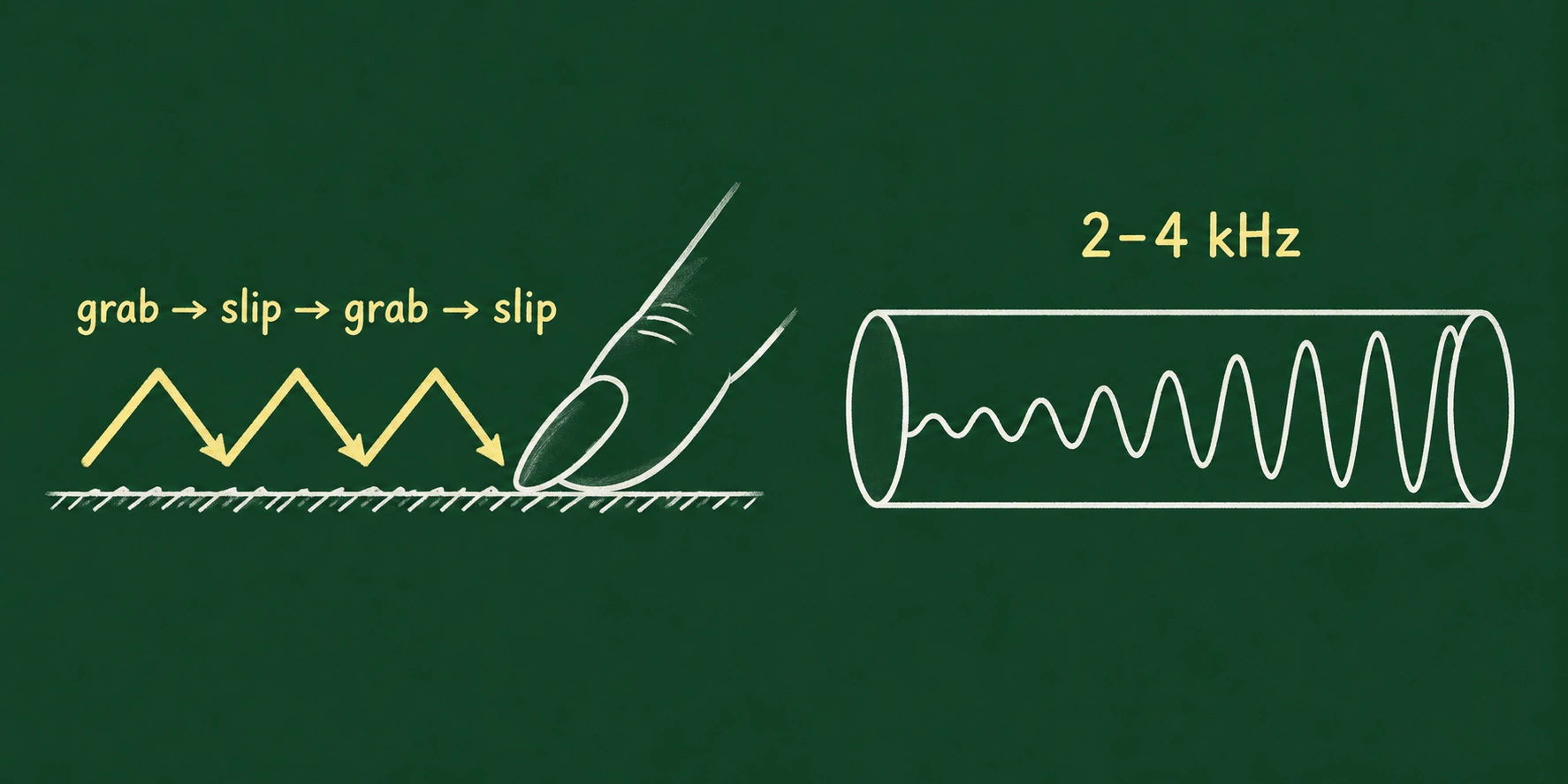
This is where the more solid answers start. In 2011, researchers in Germany played people a series of scraping sounds, including chalk and fingernails on a board, and measured not only how much people disliked them but also how their bodies reacted, through changes in sweat on the skin and heart rate. The most unpleasant part of the sound sat between about 2,000 and 4,000 Hz.
That range is no accident. The human ear canal is a small tube a few centimeters long, and like any tube, it naturally boosts certain pitches. For most people, that boost lands right around 2,000 to 4,000 Hz. It is the range where speech consonants live, so being extra sensitive there is normally very useful. The downside is that a scraping sound packed with energy in that zone gets amplified by our own anatomy before it even reaches the inner ear.
The ear is tuned to hear human voices clearly. Chalk and fingernails happen to hit that same sweet spot, so your ear turns the volume up on exactly the part of the sound you would most like to turn down.
Why scraping sounds so rough
There is also a reason the sound feels jagged rather than just loud. When a fingernail or chalk is pushed across a board, it does not slide smoothly. It grabs the surface, slips, grabs again and slips again, many times per second. Engineers call this stick-slip friction. It is the same thing that makes a violin bow sing on a string, or a door hinge squeak, or sneakers squeal on a gym floor.
Each grab and slip makes the sound shudder in volume very quickly. Researchers studying screams found that this rapid shuddering, which they call roughness, is one of the features that makes a human scream feel alarming. Ordinary speech barely has it. Screams, car alarms and many scraping sounds have a lot. So the chalkboard does not need to imitate a monkey. It shares a quality with the sound of a human in distress, and our brains are very quick to react to that.
Myth 3: It is just your ears. Your brain has nothing to do with it
False. In 2012, a team in the United Kingdom scanned the brains of volunteers while they listened to dozens of sounds, from babbling water to a knife scraping on a bottle. The worst sounds triggered a strong conversation between the hearing part of the brain and the amygdala, a region involved in fear and emotion. The more unpleasant a person rated the sound, the more these two areas interacted.
Their list of the most hated sounds is worth a look. Topping it were a knife on a bottle and a fork on a glass, followed closely by chalk on a board. The least unpleasant included babbling water and applause. The worst ones had a lot of energy in roughly the same upper middle range that the German study had found.
| Commonly blamed reason | What the research suggests |
|---|---|
| The sound is extremely high pitched | The worst part sits in the upper middle range, not the very top |
| It resembles a monkey warning call | An appealing idea that was never confirmed |
| Your ears simply cannot handle it | The ear canal boosts it, and the emotional brain reacts strongly |
| It can damage your hearing | At normal classroom levels, it is unpleasant but not harmful |
| Everyone reacts the same way | Reactions vary a lot, and context changes how bad it feels |
Myth 4: The sound is actually hurting your ears
False, in normal situations. The physical reaction is so strong that it can feel like damage, the shiver, the clenched teeth, the urge to cover your ears. But a fingernail on a board is not especially loud. It is far quieter than a motorcycle, a concert or a hair dryer held close to your head, none of which make people cringe the same way. The discomfort comes from what the sound is like, not from how much energy it carries.
Myth 5: Everyone hates it equally, no matter what
False. The German study included a clever twist. Some listeners were told the sounds came from a piece of contemporary music. Others were told the truth. The music group rated the sounds as noticeably less unpleasant. Interestingly, their bodies still reacted almost as strongly. Their skin and heart rate responded as if they disliked the sound, even while they reported that it was not so bad.
So part of the horror is what we expect. When you see a hand moving toward a chalkboard, you start bracing before any sound happens. That is also why simply reading or imagining the phrase can produce a small shiver. Your brain has learned the warning so well that it fires on the memory alone.
People also differ a great deal. Some barely react at all, while others find the sound almost unbearable. For a small group of people, reactions to certain everyday sounds like chewing, sniffing or pen clicking can be similarly intense. That condition is known as misophonia, and it is a story of its own.
If a sound like this makes you cringe
- Look away from the source. Part of the reaction is anticipation. Not watching the hand or the fork move can soften the shiver a little.
- Hum or talk over it. A low, steady sound of your own partly masks the harsh range and gives your brain something else to track.
- Use a different tool. Many classrooms switched to whiteboards for practical reasons, but a lot of teachers also do not miss the chalk screech. At home, soft-tipped markers on glass avoid the problem entirely.
- Fix the squeak at the source. Since the sound comes from stick-slip friction, anything that helps a surface slide smoothly reduces it. That is why a drop of oil silences a squeaky hinge.
The verdict
The chalkboard sound is not horrible because it is shrill, and probably not because of monkeys. It is horrible because it combines three things our bodies are very sensitive to: energy in exactly the range our ear canals amplify, a rough, shuddering texture that resembles a scream, and a brain that has learned to expect the worst the moment a hand touches the board. Knowing all that will not stop the shiver. But the next time it happens, at least you will know it is your well tuned ears and a very alert brain doing exactly what they were built to do.