
Curious Stories
Why Do You Hate the Sound of Your Own Voice on Recordings?
You hear a voice message you sent and think, is that really me? Almost everyone feels this. Your recorded voice is not broken or fake. You have simply never heard your real voice the way everyone else does. Here is why, plus a simple way to hear it for yourself.
8 min read
The first time I heard myself in a video a friend posted, I asked her to delete it. The voice in that clip was higher, thinner and somehow more nasal than the voice I hear every day. It did not sound like me at all. My friend just laughed and said, that is exactly what you sound like.
If you have ever cringed at a voice message you sent or skipped past your own voice in a video, you are in very large company. It is one of the most common reactions people have to recordings. The good news is that there is a clear physical reason for it, and once you understand it, the cringe gets a lot smaller.
You hear your own voice through two paths
When someone else talks, their voice travels through the air, into your ears, and that is the whole story. When you talk, something extra happens. Your voice still leaves your mouth and comes back to your ears through the air, but it also travels straight through your body. The vibrations from your vocal folds move through your throat, jaw and skull and reach your inner ear from the inside. This second path is called bone conduction.
Bone conduction does not carry all sounds equally. It carries the lower frequencies especially well, so it adds a deep, warm layer under everything you say. Your brain blends both paths together, and the result is the voice you know: fuller and lower than it really sounds to anyone else.
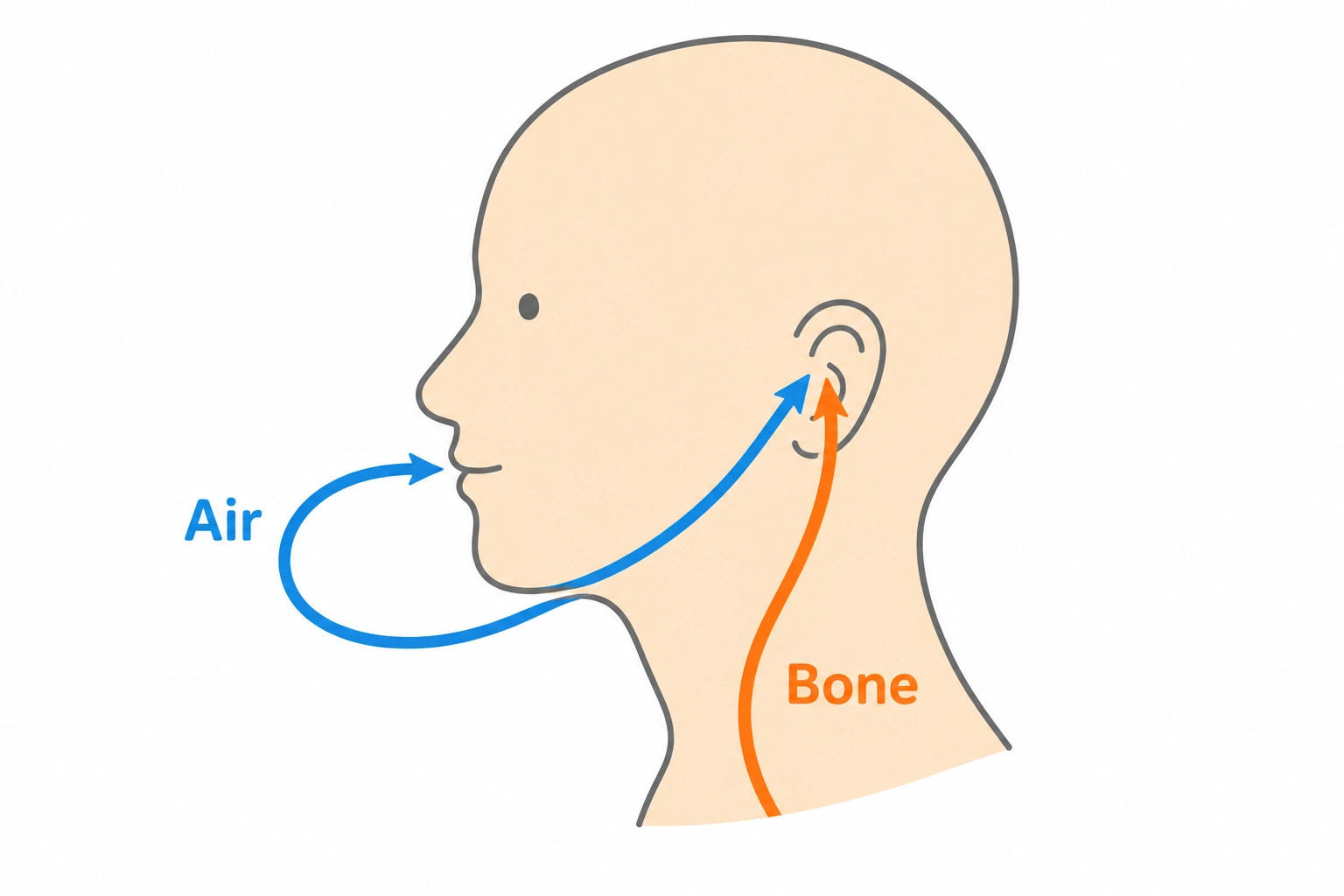
A microphone has no skull. It only picks up the air path. So when you play back a recording, that warm, bass-heavy layer you have heard your whole life is simply gone. What is left sounds higher and thinner by comparison, even though it is much closer to what other people hear every time you speak.
Try this: hear your bone conduction right now
You can feel the difference in a few seconds. Say a sentence out loud at a normal volume. Then press your fingers gently into both ears, or press the small flaps in front of your ear canals closed, and say the same sentence again.
Your voice suddenly gets louder, deeper and boomier, even though you are blocking your ears. That is bone conduction with the air path partly cut off. Audiologists call this the occlusion effect, and it is the same reason your own chewing sounds so loud when you wear earplugs.
To get a rough idea of the opposite, how you sound to others, hold a stiff folder or a hardcover book so it makes a little channel from the side of your mouth to one ear, and talk. More of the air path reaches you, and the voice starts to sound closer to a recording. It is not perfect, but it is a surprising preview.
Your ears also turn themselves down when you talk
There is a second, less known reason your voice sounds different in your own head. Inside your middle ear there are two tiny muscles. One of them, the stapedius, is the smallest skeletal muscle in the body. When you are about to speak, these muscles tighten slightly and reduce how much sound passes through, a bit like your ear lowering its own volume. This helps protect your hearing from your own voice, which is very close and fairly loud.
That dampening affects the air path while you speak, but it is not active when you are listening back to a recording. So the recorded version not only lacks the bone conduction bass, it also reaches your ears without the filter you are used to. Two small changes stacked together make it feel like a stranger is talking.
| Who is listening | What they hear | How it sounds |
|---|---|---|
| You, while speaking | Air path plus bone conduction, partly dampened | Deeper, warmer, fuller |
| Other people | Air path only | Your real voice |
| You, listening to a recording | Air path only, through a microphone and speaker | Close to what others hear, but feels strange to you |
It is not only physics. It is also familiarity
If the difference were just a bit less bass, we would probably shrug it off. But many people find their recorded voice genuinely unpleasant. Psychologists noticed this back in the 1960s and gave it a name: voice confrontation. In an early study, people who heard recordings of themselves often reacted with discomfort and even anxiety, while people listening to the same recordings of someone else felt nothing special at all.
A big part of the explanation is familiarity. Humans tend to like things more the more often we encounter them. Psychologists call this the mere exposure effect. You have heard the inside version of your voice tens of thousands of times. The outside version is a rare, unfamiliar copy, and unfamiliar versions of familiar things tend to feel slightly wrong.
Faces work the same way, which I found fascinating. In a well known experiment from the 1970s, researchers showed people two photos of themselves: a normal one and a mirror-flipped one. Most people preferred the flipped version, because that is the face they see in the mirror every morning. Their friends preferred the normal photo, because that is the face they actually see. Your voice is going through exactly the same thing. You are attached to the mirror version.
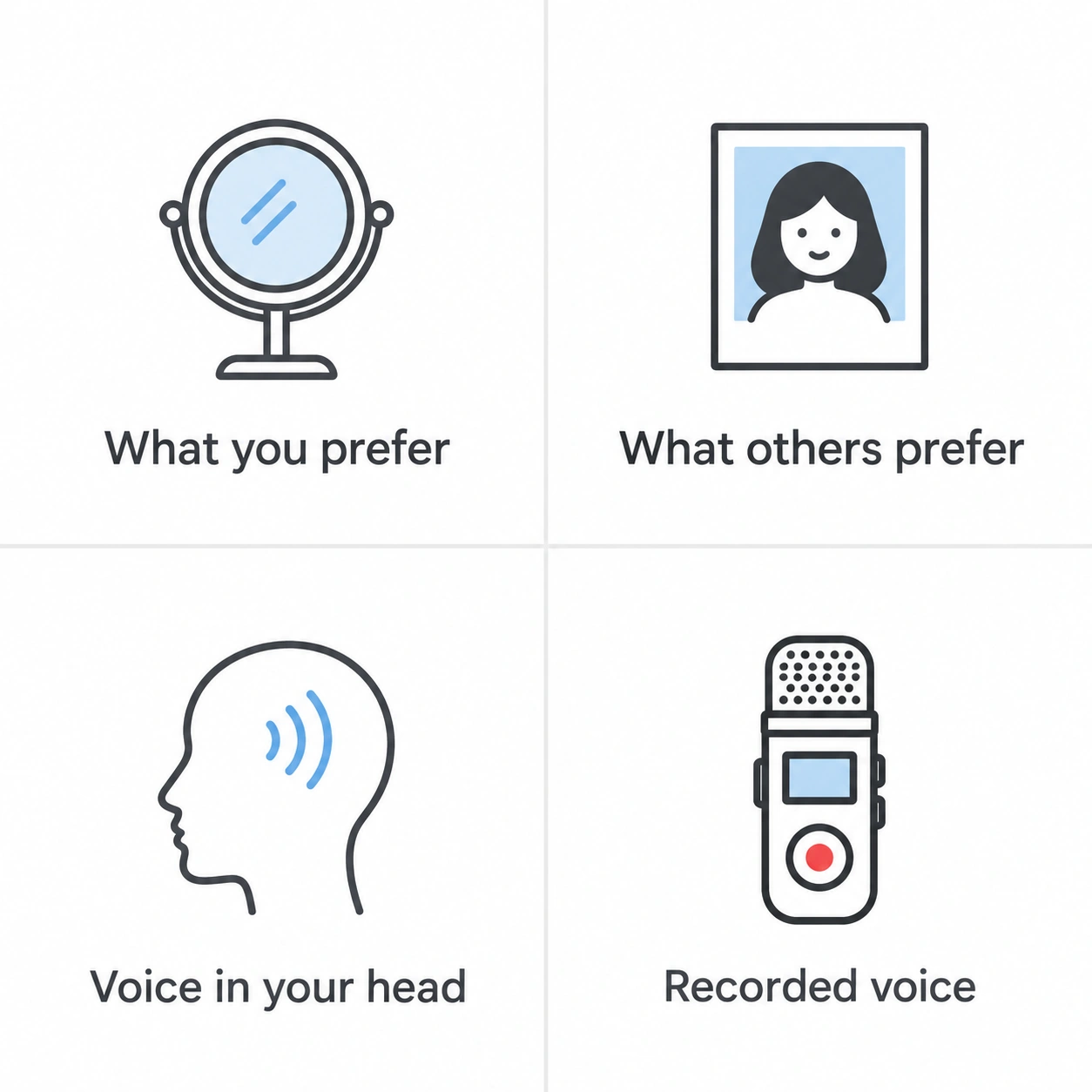
You actually like your voice more than you think
Here is the part that changed how I feel about it. In a 2013 study, researchers had people rate the attractiveness of a series of short voice recordings. Mixed in, without warning, were recordings of the participants themselves. Many people did not recognize their own voice in the lineup, and when they did not, they tended to rate it as more attractive than the average stranger.
In other words, the problem is not the voice. When people hear it without knowing it is theirs, they often like it. The discomfort comes from recognizing it and noticing that it does not match the version in their head. Add a little self-consciousness about every small hesitation and filler word, and the cringe takes over.
The voice in the recording is the one your friends, family and coworkers have always heard, and they are perfectly happy with it. You are the only person who finds it unfamiliar.
Is the recording really how I sound?
Mostly, yes, with a few caveats. A recording captures the air path, which is what other people hear. But the quality of the recording changes things. A phone microphone held close to your mouth, a cheap earbud mic or a heavily compressed voice message can all make a voice sound thinner, harsher or more nasal than it really is in person. Playback through tiny phone speakers removes even more of the low end.
So if a voice message makes you wince, part of that may genuinely be the phone, not you. A decent microphone placed a little away from your mouth, played back on good headphones, gets much closer to how you sound standing across a table from someone.
How to get comfortable with your recorded voice
The mere exposure effect works in both directions. The more you hear your recorded voice, the more familiar it becomes, and the less strange it feels. Podcasters, radio hosts and video creators almost all say they disliked their own voice at the start and stopped noticing within a few months. These are the habits that helped me.
- Listen on purpose, a little at a time. Record yourself reading a paragraph for thirty seconds, a few times a week, and listen back. Short, regular exposure works much better than one painful long session.
- Listen on headphones, not the phone speaker. Good headphones bring back much of the warmth that small speakers remove, so you hear a fairer version of your voice.
- Keep the microphone at a sensible distance. About a hand span, roughly 15 to 20 centimeters, from your mouth usually sounds more natural than speaking right into it, and cuts down on breath and pop sounds.
- Judge the delivery, not the tone. You cannot change the basic sound of your voice much, but you can change your pace, your pauses and how clearly you finish your words. Those are what listeners actually notice.
- Remember who is listening. Everyone else already knows this voice. They have heard it in every conversation you have ever had with them. To them, the recording just sounds like you.
The voice everyone else already knows
For most of my life I believed the voice in my head was the real one and the recording was the distorted copy. It is closer to the opposite. The version in my head is the special one, shaped by bone conduction, ear muscles and years of habit. The recording is the voice that has been doing all the talking to everyone else the whole time. Knowing that did not make me love hearing myself overnight, but it did stop me from asking friends to delete their videos. Next time your recorded voice catches you off guard, try thinking of it this way: you are just hearing yourself the way the people who like you always have.